The complete architecture, explained for executives
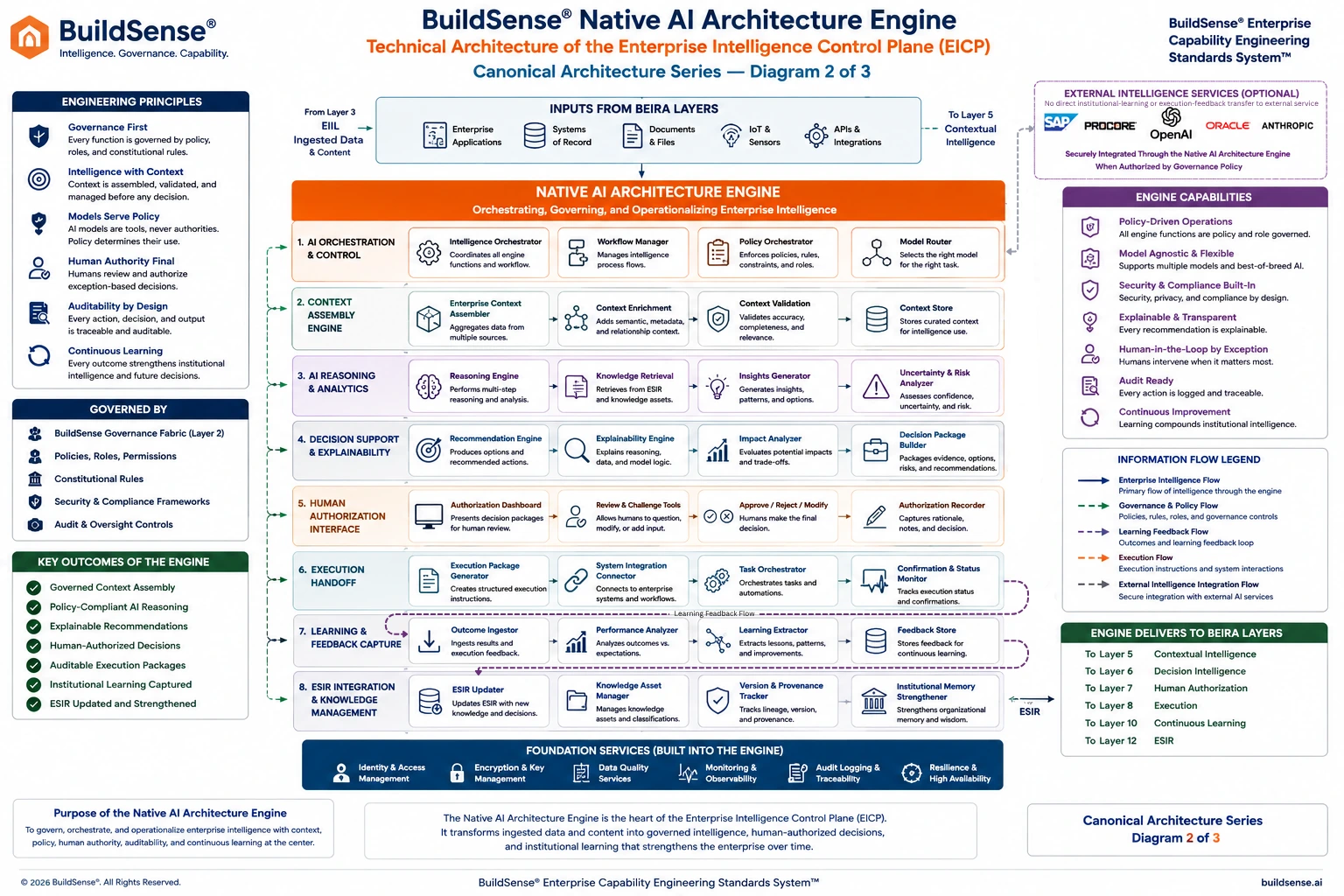
The full diagram shows every part of the BuildSense Native AI Architecture Engine. This guide explains what it does in plain terms, so you can read the diagram with the main ideas already in mind.
Four questions the architecture answers
The eight functions of the engine work in four stages. Each stage answers one question a leadership team would ask about any important decision.
-
Contextual review
What is the situation?
Information comes in from enterprise applications, systems of record, documents, sensors and APIs. The engine assembles it, checks it for accuracy, completeness and relevance, and reasons across it together with knowledge already held in ESIR. AI Orchestration and Control runs the flow, applies policy and routes each task to the right model.
Steps 1 to 3 -
Governed action
What should we do, and who decides?
The engine builds a decision package with the evidence, options, impacts, risks and a recommendation, and explains its reasoning. Where governance requires human judgment, people can question, approve, reject or modify it, and their rationale is recorded. Approved decisions go to the teams and systems that carry them out, and their status is tracked.
Steps 4 to 6 -
Outcome verification
Did it work?
Results are captured after the work is done and compared with what was expected.
Step 7 -
Reusable learning
What should we keep?
Lessons and improvements are drawn from those results. Each lesson is validated and approved by an accountable owner, and ESIR Integration then adds it to institutional memory with its version and provenance tracked. Approved learning remains subject to ongoing review.
Validation, then Step 8
This page describes the architecture as designed. Which components are available for your environment is confirmed in the Outcome Assessment, and applications not yet validated in a client deployment are proposed for pilot validation.
Four things that matter to leadership
Authority stays with you
Your governance rules decide who holds authority. People are brought in where those rules require human judgment, and they can approve, reject or modify a decision.
Not tied to one model
A model router sends each task to the right model. The engine is designed to support model replacement while preserving the surrounding architecture, subject to integration testing and revalidation. External AI services are optional and receive no direct transfer of institutional learning or execution feedback.
Every decision is traceable
Human authorizations are recorded with their rationale, audit logging runs across the engine, and every knowledge asset keeps its version and provenance history.
Knowledge is approved before reuse
Feedback is captured from every cycle, but a lesson becomes institutional knowledge only after an accountable owner has validated and approved it, and it remains subject to ongoing review.
Where to look
The diagram is laid out in the same way throughout. This is where each part sits.
Inputs
The data the engine works from, coming from enterprise applications, systems of record, documents, IoT sensors and APIs.
The eight functions
One row per function, in order from orchestration to ESIR integration. Each row shows the four components that do that work.
Governed by
The governance fabric, policies, roles, constitutional rules, compliance frameworks and oversight controls that apply to every function.
Foundation services
Identity and access, encryption, data quality, monitoring, audit logging and resilience, built into the engine.
External services and outputs
Optional external AI services, used only when governance policy authorizes it, and the intelligence the engine delivers to other layers.
Arrow colors
Five flows are shown. Intelligence, governance and policy, learning feedback, execution, and external integration.
BuildSense architecture diagram
Use the four stages and the reading guide above when going through it.
Start with the outcome you need
Tell us the institutional outcome you are working toward. An Outcome Assessment maps the capability, intelligence, infrastructure and governance it requires, and shows whether a governed pilot is worth pursuing.