The BuildSense Native AI Architecture Engine
Model-agnostic by architecture. Governance-aligned by design. One engine that moves from context to governed action, verifies the outcome and admits only validated and approved learning for reuse.
Eight functions, one governed flow
The engine is the architecture behind the Enterprise Capability Engineering Methodology™ (ECEM). ECEM defines the outcome and the capability it requires, and the engine is designed to carry that capability into governed operation.
Each function has a clear responsibility. Together they turn enterprise data into decisions the organization can stand behind. A validation and approval step sits between learning and institutional memory, so only validated and approved learning is admitted for reuse, subject to ongoing review.
-
AI Orchestration and Control
Coordinates every engine function and the workflow between them, so each step runs in the right order with the right inputs.
-
Context Assembly Engine
Brings together, validates and enriches the data context a decision depends on, before any reasoning begins.
-
AI Reasoning and Analytics
Performs multi-step reasoning across the assembled context and produces structured insight.
-
Decision Support
Turns insight into clear options, with the trade-offs and risks of each one laid out.
-
Human Authorization, Exception-BasedGovernance checkpoint
Enterprise action proceeds under governed organizational authority. Human authorization is invoked only when governance requires human judgment.
-
Execution Handoff
Creates structured execution instructions and workflows that downstream teams and systems can act on.
-
Learning and Feedback Capture
Ingests execution results and checks them against the intended outcome. Lessons are recorded as candidates for review, not yet as institutional knowledge.
-
Validation and approvalBefore institutional reuse
Each candidate lesson is reviewed against the verified outcome and approved by an accountable owner before it is admitted for reuse. Feedback that is captured but not approved stays out of institutional memory, and approved learning remains subject to ongoing review.
-
ESIR Integration
Adds validated and approved learning to knowledge assets and institutional memory, where it remains subject to ongoing review.
Designed, available and proposed for validation
We keep these three apart, so you always know what you are looking at.
What this page describes
The eight functions, the validation and approval step and the governance model shown here are the architecture as designed.
What is ready for your environment
Which components are implemented and ready for your systems is confirmed in writing during the Outcome Assessment, before any pilot is agreed.
What a pilot must show
Applications such as the construction RFI example, and the results they aim for, are proposed for validation in an Enterprise Pilot. We do not present them as proven until a pilot has measured them.
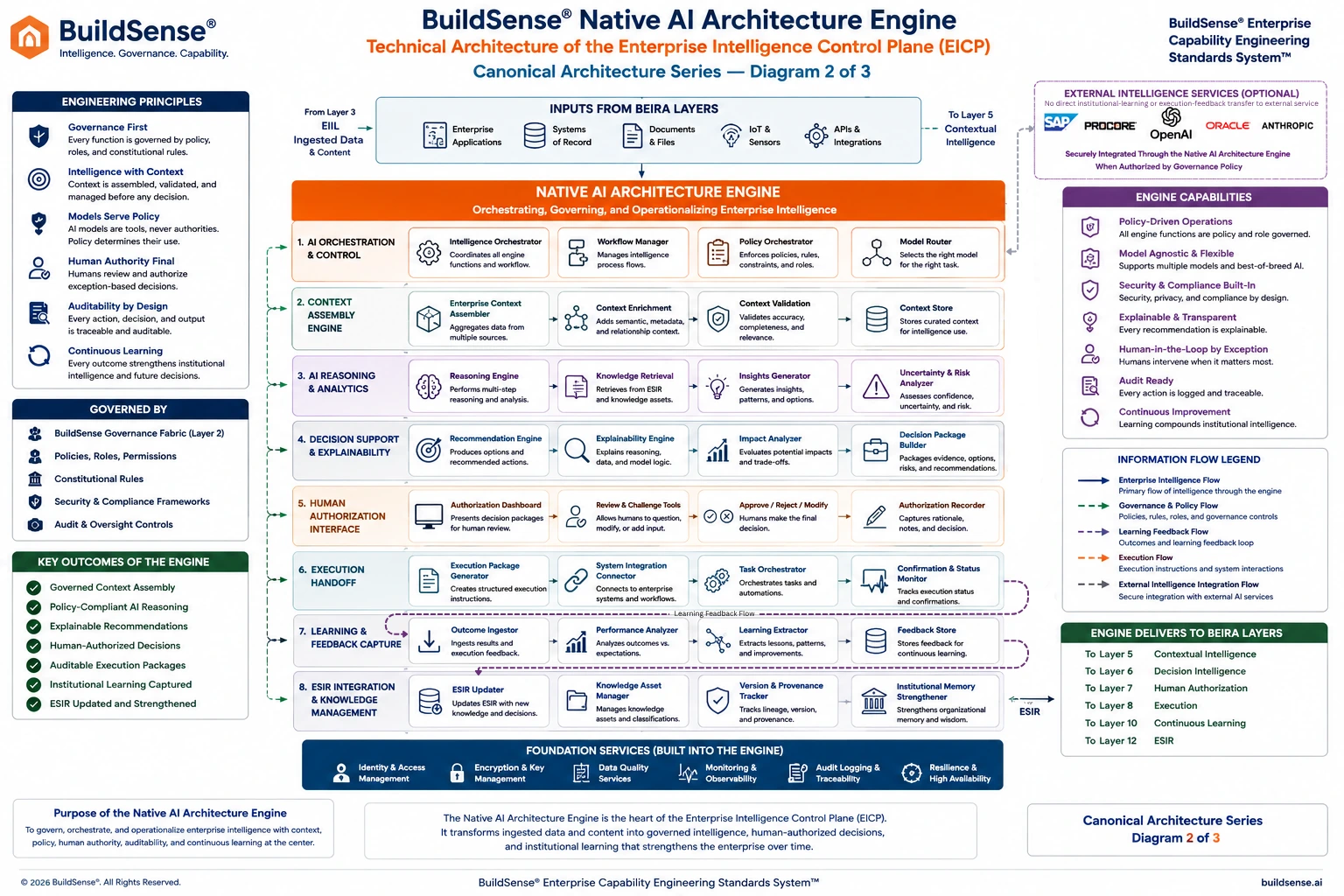
See the complete diagram, explained
The full architecture diagram has its own page, with a short guide that explains what each part does in plain terms. It is written for executives who want the main ideas before the technical detail.
View the full architectureWhy the engine is built this way
Model-agnostic by architecture
AI models are treated as components, not as the foundation. The engine defines how context, reasoning and decisions connect, and it is designed to support model replacement while preserving the surrounding architecture, subject to integration testing and revalidation.
Governance-aligned by design
Governance is built into the flow from the start. Enterprise action proceeds under the organization's own authority, and the engine asks for human judgment where governance requires it.
Exception-based human authorization
People approve the decisions that governance marks for human review. Routine steps proceed under the authority the organization has already set.
Validated institutional memory
Capturing feedback alone does not make it enterprise knowledge. Through ESIR integration, only lessons that an accountable owner has validated and approved are written back into the organization's knowledge assets.
BuildSense does not automate authority. BuildSense governs intelligence.
Start with the outcome you need
Tell us the institutional outcome you are working toward. An Outcome Assessment maps the capability, intelligence, infrastructure and governance it requires, and shows whether a governed pilot is worth pursuing.